
The Moment a Shop Outgrows Generic Folder Comparisons
A shop usually outgrows generic comparisons for one of three reasons. The first is part length. Once the work includes long coping, parapets, fascia, roof edge profiles, or facade components, sheet control becomes its own topic. The second is part visibility. If the business is producing pieces that customers will see up close, finish quality and repeatability carry more weight than simple output claims. The third is mix. A shop handling standard trim one hour and custom profiles the next needs a machine that does not become fragile every time the part changes.
That is why serious buyers talk less about whether a machine can technically bend metal and more about how it gets through a day of real jobs. Across customer stories and manufacturer articles from companies such as TRUMPF, Bystronic, Prima Power, LVD, and CIDAN, the pattern is consistent: the strongest content is rarely about isolated specs. It is about labor pressure, changeover time, programming clarity, automation that actually helps, and the ability to keep difficult work moving without depending on one exceptional operator.
That shift in language matters because it leads to better buying questions. A machine can be impressive in a showroom and still create friction in production if the handling logic is awkward, the control is harder than it first appears, or the machine only feels smooth on easy parts. Shops that make good long-term decisions usually catch that difference early.
Why the Best Comparisons Start with Workflow, Not with Marketing Labels
One of the easiest mistakes in this category is to compare brands only through product labels. Every builder has its own naming system, control terminology, and house language for automation. That can make the market look more fragmented than it really is. When buyers strip that away, the practical questions are surprisingly consistent.
They want to know how the sheet is supported before the bend, during the bend, and after the bend. They want to see how the control behaves when the profile is edited. They want to understand whether alternating bends stay orderly or start to feel fussy. They want to know how much manual repositioning still remains when the work gets longer or more delicate. And they want to judge whether the machine encourages standardized production habits or still relies too heavily on operator improvisation.
That is the level where the conversation becomes useful for ARTITECT too. The machine functions published on the company's site already point in that direction. A supplier talking openly about grippers, tapered backgauge units, side loading, graphic control, and part flipping is not framing the machine as a simple brake replacement. It is framing the system as a production platform for shops that want more control over handling, consistency, and throughput.
What Experienced Buyers Usually Bring into the Demo Room
Buyers who have been through a few machinery investments tend to arrive more prepared than they did the first time. They are less impressed by generic capability statements and more interested in how the machine deals with their own difficult parts. They also know that the weakest part in a demonstration is often not the machine itself, but the choice of demo part. If a supplier only runs clean, simple shapes, the buyer learns very little.
The most useful demo package usually includes real work from the shop floor, especially parts that expose handling weaknesses or sequence complexity. That may mean long flashings, alternating bends, finish-sensitive profiles, tapered details, or repeat jobs where labor time has become frustratingly high.
- Bring one standard high-volume part so the supplier can show how the system behaves on the work that actually pays the bills.
- Bring one awkward part that currently creates delays, rehandling, or operator frustration.
- Bring one finish-sensitive part so sheet support and movement can be judged realistically.
- Ask a second person to review the control because intuitive programming matters most when more than one operator must run the machine.
- Watch the transitions, not just the bend since loading, gauging, supporting, and unloading often reveal more than the actual fold.
This is where article language from companies like TRUMPF and LVD can be instructive. Their better pieces do not present equipment as a static object. They present it as part of a production story: a shortage of skilled labor, an increase in complexity, a need for cleaner repeatability, or a business trying to grow without adding chaos. That is a more useful lens for comparing metal folding machines because it reflects how the buying decision is actually made inside a shop.
Where Metal Folding Machines Start to Separate from One Another
At a distance, many advanced folders seem to promise the same outcome: more automation, easier programming, and better productivity. In practice, separation usually happens in a handful of specific places. The first is openness around the work area. A machine that gives the operator better visibility and more natural access tends to feel less stressful on complicated profiles. The second is control behavior. Some systems look powerful but slow the team down because simple edits or repeat runs feel less intuitive than expected.
The third is support for long and flexible sheets. Roofing and facade shops know that the bend itself is only part of the challenge. Keeping a long part stable, aligned, and cosmetically clean through the sequence is where a machine proves whether it is truly suited to architectural work. The fourth is automation depth. This is not about collecting optional equipment for its own sake. It is about whether automation reduces real handling burden and makes quality easier to repeat.
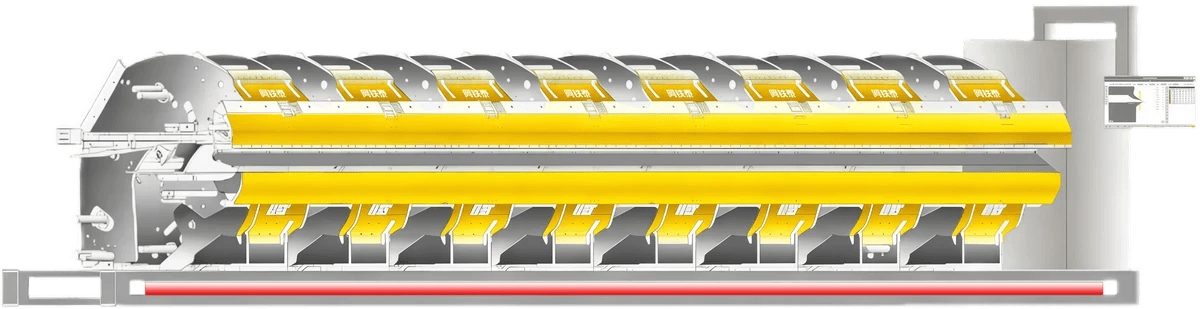
That is also why the ARTITECT feature set deserves a closer reading. Functions such as automatic extendable sheet loading and support, automatic side loading, material grippers, and an automatic part flipper are meaningful because they speak directly to sheet movement through the process. For many buyers, that is the difference between a machine that looks advanced and a machine that materially changes the workday.
Why ARTITECT Gets Attention in Roofing and Facade Work
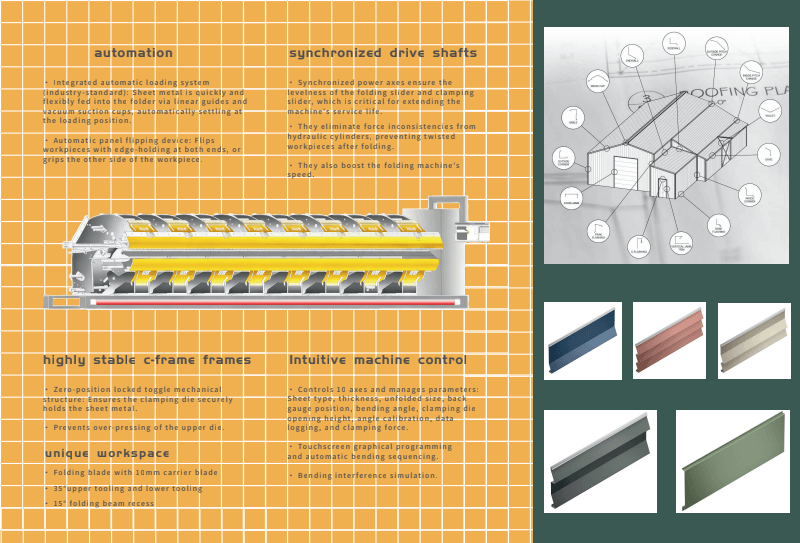
ARTITECT MACHINERY's position is strongest when the discussion centers on roofing, cladding, flashing, and architectural profiles that demand controlled movement rather than brute-force bending alone. The company does not need to pretend to serve every imaginable sheet metal scenario equally. In fact, its positioning is clearer when it does not. The message on the website is already more focused than that: a double folder for roofers and contractors, supported by machine functions that point toward coordinated handling and automated production steps.
That focus can be an advantage in a market where some content tries to cover too many applications at once. Buyers with a roofing and facade background usually respond well to suppliers that seem to understand where time is really lost: repositioning, unpredictable support, surface damage risk, and the constant mental effort required to keep long parts under control. ARTITECT's published capabilities line up with those pressures in a way that feels relevant rather than generic.
It also gives the sales conversation a cleaner shape. Instead of trying to win every comparison on abstract generality, ARTITECT can win by showing that the machine has been thought through for the jobs many architectural metal shops actually run. That is a more credible position, and it usually leads to a stronger article as well.
How Buyers Use Competitor Content Without Letting It Drive the Decision
Competitor content is useful, but not because it tells the buyer who to choose. It is useful because it reveals what respected builders want buyers to notice. Across Bystronic magazine pieces, Prima Power articles, TRUMPF customer stories, and LVD updates, recurring themes show up again and again: operator shortages, digital workflow, machine flexibility, automation that reduces handling, and the need to standardize quality while shops take on more varied work.
Those themes are helpful because they keep the conversation grounded in business reality. They also prevent buyers from reducing the comparison to a simplistic checklist. If several established manufacturers keep talking about workflow, labor efficiency, and changeover stability, that is a sign that these are structural buying issues, not just marketing trends.
For ARTITECT, this is useful in a second way. It gives the company a richer content context without forcing it to imitate anyone. The better lesson is not to copy another brand's tone. The lesson is to write and sell closer to the shop floor: fewer abstract claims, more concrete discussion of production pressure, part handling, and output consistency. That is the direction strong product blogging tends to go in this category.
The Questions That Usually Decide the Investment
By the time a buyer narrows the field, the remaining questions are rarely dramatic. They are often very practical, and that is exactly why they matter. How fast can the team get comfortable with the control? Can the machine handle the parts that currently create the most frustration? Does the system look stable when the sheet gets long or delicate? Does the supplier seem honest about what still requires operator judgment?
Another important question is whether the machine will still fit after the next phase of growth. Many shops are not buying only for today's part mix. They are buying for future complexity, future labor realities, and a future in which consistent output matters even more than it does today. A metal folding machine that solves only the current bottleneck may still leave the business exposed a few years later.
This is where an inquiry through ARTITECT's contact page should lead to more than a brochure and a price discussion. Buyers should be pushing for application-specific conversation, part review, and a realistic match between machine behavior and production goals. Good machinery content should set up that conversation, not substitute for it.
What a Better Decision Usually Looks Like
A better decision in this market does not always mean choosing the machine with the longest options list. It usually means choosing the system that matches the shop's actual rhythm. The best investment is often the one that makes the team more repeatable, reduces physical and mental handling burden, and gives the business more confidence when the work becomes less predictable.
That is why metal folding machines are best judged at the intersection of capability and behavior. Capability explains what the machine can do. Behavior explains how reliably it will do it on a Tuesday afternoon with mixed work, time pressure, and no tolerance for damaged parts. Shops that keep those two ideas separate usually buy more wisely.
For roofing and facade operations, ARTITECT MACHINERY is most compelling when viewed through that lens. The company's published focus on double-folder functions, handling support, and automated sheet movement is not an accessory to the story. It is the story. And for the right buyer, that is exactly the point.
Conclusion
The metal folding machines worth serious attention are not separated by marketing language alone. They are separated by how well they handle long, visible, varied work and how effectively they turn difficult fabrication into repeatable daily output. That is why experienced buyers compare workflow, control clarity, support systems, and sheet handling more carefully than they compare headline specifications.
ARTITECT MACHINERY belongs in that higher-value comparison because its published machine functions already speak the language that matters in roofing and architectural fabrication. For buyers who have moved past generic folder shopping and are now evaluating double-folder level performance, that is the comparison space that matters most.