
A bending metal machine may sound like a simple shop purchase, but the right choice depends on what the shop actually needs to produce. For roofing and architectural sheet metal work, the machine often has to form long visible profiles, repeat dimensions across project runs, support several materials, and reduce manual handling around each bend.
That is why many buyers should look closely at double folder technology. ARTITECT MACHINERY presents itself as a double folder factory and describes an automatic folding machine for roofers and contractors on its Functions page. Its machine functions are tied to real shop problems: synchronized movement, dynamic folding, CNC thickness adjustment, backgauge and gripper control, graphic programming, sheet loading, side loading, and automatic part flipping.
Simple Bends Are Not the Whole Job
Many machines can make a simple bend. The harder question is whether the machine can support the full profile. Roofing and architectural parts may include hems, offsets, returns, box-like forms, coping shapes, and facade details. The operator may need to bend the part several times while keeping long material square and undamaged.
A good buying decision should therefore begin with the finished profile, not the machine label. How long is the blank? How many bends are required? Do bends face both directions? Is the surface prefinished? How often does the shop repeat the part? These questions reveal whether a basic bending approach is enough or whether a double folder offers a better production path.
Why Double Folder Workflow Helps
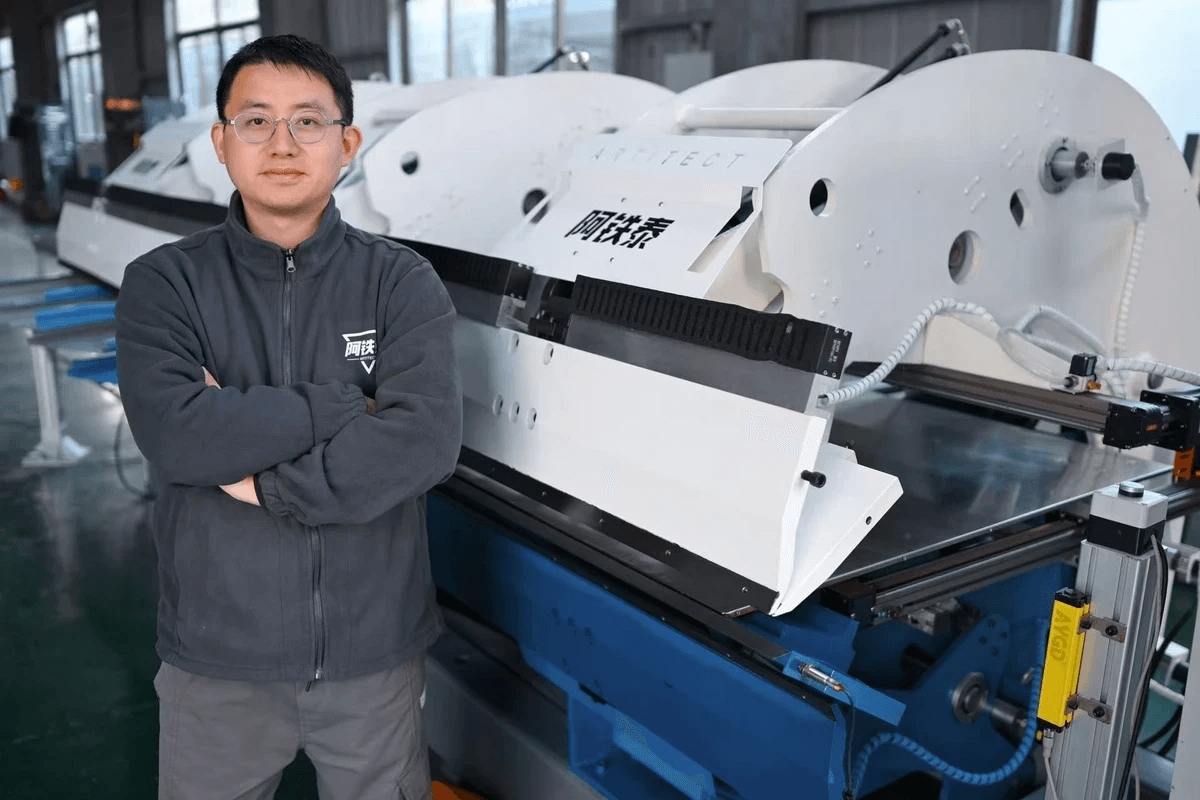
A double folder can fold upward and downward, which can reduce the need to flip the material between bend directions. RAS describes up and down bending as a way to avoid material flipping when the bend direction changes. This is valuable because flipping a long or partly formed profile is often one of the slowest and riskiest steps in production.
Less flipping can improve the shop's rhythm. It can also reduce surface damage, protect alignment, and lower operator fatigue. When the work includes long roofing trim, parapet caps, fascia, gutters, or cladding details, that improvement can be more important than a single headline specification.
Long Material Needs Machine Support
Long sheet metal blanks are not easy to manage manually. They can flex, twist, and drag. If the part is coated or painted, poor handling can create visible marks. If the blank is not supported evenly, the operator may need a second person to prevent movement during the sequence.
ARTITECT lists automatic extendable sheet loading and sheet support, automatic side sheet loading, and automatic part flipping. These functions are relevant because they reduce the amount of physical work required around the bend. NIOSH guidance on manual material handling notes that ergonomic improvements can reduce physical demands and may improve productivity and quality. In this kind of shop, support systems can be productivity systems.
Backgauge Accuracy Makes the Profile Repeatable

When a shop produces several pieces for the same roof edge or facade run, repeatability matters. ARTITECT lists backgauge and material gripper functions, as well as a tapered backgauge unit. These functions help position the blank consistently and support profile types that are not always simple rectangles.
Buyers should ask to see how the machine positions a real part. A good demonstration should show the gauge, gripper, operator prompts, and finished result. If the operator still needs to correct each bend by eye, the machine may not deliver the repeatability the shop expects.
CNC Control Should Make the Job Easier to Teach
A bending metal machine is often used by more than one person. As a shop grows, it may need newer operators to run repeat jobs without relying entirely on one expert. ARTITECT describes graphic control EFsys with touch-screen profile programming, automatic folding sequence, and collision simulation. These features can make complex work easier to understand and repeat.
A clear control workflow is especially useful for custom architectural parts. The operator can review the profile, follow a planned sequence, and reduce the chance of bending in the wrong direction or creating interference. RAS also highlights automatic programming and simulation in its bending center materials, showing that software support is an important part of modern folding work.
Material Changes Should Not Create Chaos
Roofing and architectural shops often bend different materials depending on the project. Coated steel, aluminum, copper, zinc, and stainless steel all behave differently. ARTITECT lists CNC material thickness adjustment, while Jorns describes automatic material thickness adjustment on its double bending machine materials.
The practical question is how quickly the shop can move from one material to another while maintaining quality. If setup depends heavily on trial and error, production becomes less predictable. A machine that controls thickness adjustment more clearly can reduce setup variation and help protect finished parts.
Safety Cannot Be Added at the End

Bending equipment includes moving beams, clamping areas, gauges, and large material. OSHA's machine guarding guidance emphasizes safeguarding machine parts and processes that can injure workers. Buyers should evaluate guarding, emergency stops, operator access, safe loading routines, and training requirements early in the process.
A safer workflow is usually a more predictable workflow. When the operator knows where to stand, how the material is supported, and what the machine will do next, production becomes easier to control. This is especially important when long parts extend into the surrounding work area.
What to Test Before Buying
A buyer should test the machine with parts that represent real shop difficulty. A simple bend sample is not enough. The demonstration should show how the machine handles long material, finish-sensitive surfaces, several bends, bend-direction changes, and repeat production.
- Run a long roof trim profile that needs stable support.
- Run a coping or parapet cap with several bends.
- Run a part with bends in both directions.
- Run a prefinished material and inspect the surface after bending.
- Ask the operator to recall a saved program and repeat the part.
- Watch the safe loading and unloading routine for the finished profile.
Use Production Notes, Not Memory
Before a demonstration, buyers should write down the problems they want the machine to solve. It is easy to forget details once the machine is running. Useful notes include the number of operators required for a current part, the time spent repositioning, the surfaces most likely to scratch, and the bend steps that create the most confusion. Those notes make the evaluation more honest.
After the demonstration, compare the machine against those notes. Did it reduce the difficult handling step? Did it make the sequence easier to understand? Did the support system protect the surface? Did the operator need less manual correction? This approach turns a machine demo into a practical production review instead of a general sales presentation.
Where ARTITECT MACHINERY Fits
ARTITECT MACHINERY fits shops that need more than a general bending metal machine. Its About Us page connects the automatic folding machine with production and architectural design experience, which is relevant for buyers who produce roofing and facade profiles.
The most useful inquiry through the contact page will include drawings, blank lengths, materials, thicknesses, finish requirements, and the current handling problem. That gives ARTITECT the context needed to discuss whether a double folder workflow is the right match.
Conclusion
A bending metal machine should be judged by the profile workflow it supports. For roofing and architectural sheet metal shops, the best machine is often the one that reduces flipping, supports long blanks, guides the operator, controls material setup, and produces repeatable finished parts.
A double folder can be the smarter category when simple bending is no longer the main challenge. The real value appears when the machine makes difficult profiles easier to run every day.