
What Industrial Buyers Actually Need from a Folding Machine
Industrial buyers usually care about more than bending force or machine length. They are looking for throughput stability, reliable repeatability, operator efficiency, quality consistency, and a machine that does not become the weakest link once orders become more varied. That is especially true in roofing and architectural fabrication, where shops often shift between custom profiles, longer runs, and finish-sensitive parts without the luxury of resetting the whole workflow every time.
In those environments, an industrial folding machine has to do more than bend accurately. It has to control the workpiece well, support quick transitions, and reduce the amount of manual handling that slows output or creates unnecessary variation. That is why double folder systems become so relevant in advanced industrial work.
ARTITECT MACHINERY's About Us page describes a focus on automatic folding systems for roofing and architectural fabrication. That positioning matches the needs of shops where industrial performance is measured by workflow gains, stable quality, and lower handling burden.
Why High-Mix Production Changes the Buying Criteria
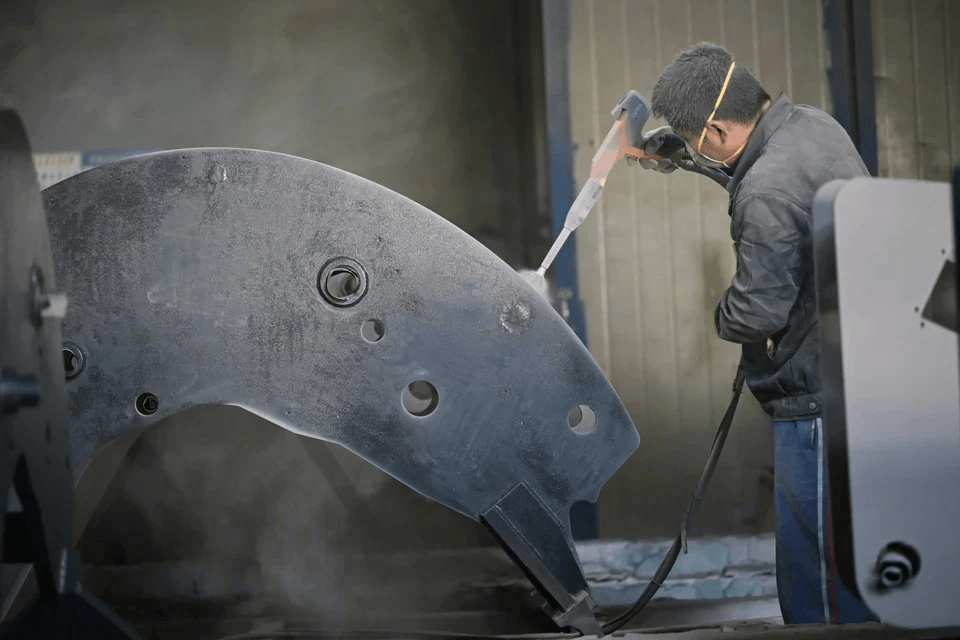
High-mix production puts stress on every weak point in a fabrication process. If the machine depends heavily on repeated manual part handling, long setup recovery, or too much operator judgment between bend directions, the cost of variation starts to climb quickly. That is why a machine that appears fine in repetitive, low-complexity work may become frustrating in a shop that runs many profile types in the same week or even the same shift.
Double folders are attractive in this environment because they are designed around more controlled sequencing. The ability to work through up and down bends with less part flipping is not just a comfort feature; it directly affects changeover rhythm, part quality, and labor efficiency. It also makes the machine more scalable when the product mix becomes more demanding.
This is one reason ARTITECT MACHINERY emphasizes dynamic folding, CNC material thickness adjustment, graphic control EFsys, tapered backgauge capability, and automated handling features. Together, those functions suggest a machine architecture built for mixed industrial production rather than only for straightforward repetitive bends.
Comparison Table: Standard Industrial Folder vs. Double Folder Workflow
| Production Priority | Standard Industrial Folder | Double Folder Workflow |
|---|---|---|
| Mixed-profile flexibility | Varies by tooling and operator handling effort | Usually stronger where alternating bends and complex parts are common |
| Operator workload on long parts | Can remain relatively high | Often reduced through better part control and support |
| Automation fit | May rely more on add-ons or operator discipline | Commonly built around CNC sequencing, loading, support, and flipping logic |
| Repeatability across shifting jobs | Good, but more sensitive to handling variation | Better suited to controlled, repeatable movement across diverse parts |
| Fit for roofing and facade systems | Capable in many cases, depending on part complexity | Often more aligned with long, visible, complex architectural profiles |
Where a Double Folder Creates Industrial Value
Industrial value in this field is rarely about one isolated speed claim. It comes from reducing friction across the whole production cycle. A double folder can create value in several ways at once:
- Lower manual handling per part: Especially useful when sheets are long or awkward.
- More stable repeatability: Controlled sequencing reduces opportunities for re-positioning error.
- Better labor efficiency: One operator can often manage more of the sequence with less interruption.
- Stronger support for advanced profiles: Important in roofing, facade, and custom cladding work.
- Cleaner scaling path: Automation features help the machine stay productive as job complexity grows.
These points explain why the most valuable industrial folding machine is not always the one with the simplest headline specs. It is the one that preserves output quality and workflow momentum when the part mix becomes harder.
What Features Industrial Buyers Should Prioritize
ARTITECT MACHINERY's function list offers a good framework for evaluation because it focuses on capabilities that change daily production outcomes:
- Synchronized control drive shaft technology: Relevant to machine stability and long-term consistency.
- Dynamic folding: Multiple machine axes moving together reduces repositioning delays.
- CNC material thickness adjustment: Supports precision while protecting the machine.
- Backgauge and material gripper systems: Critical for accurate positioning on long and complex parts.
- Tapered backgauge capability: Important where advanced profile geometry is part of the mix.
- Automatic loading, sheet support, and part flipping: These are industrial productivity functions, not just convenience functions.
Buyers should also think about how these systems work together. The strongest industrial machine is not the one with the longest feature list. It is the one whose features support the same production logic from programming through finished part handling.
Why Roofing and Architectural Fabricators Often Choose Double Folders
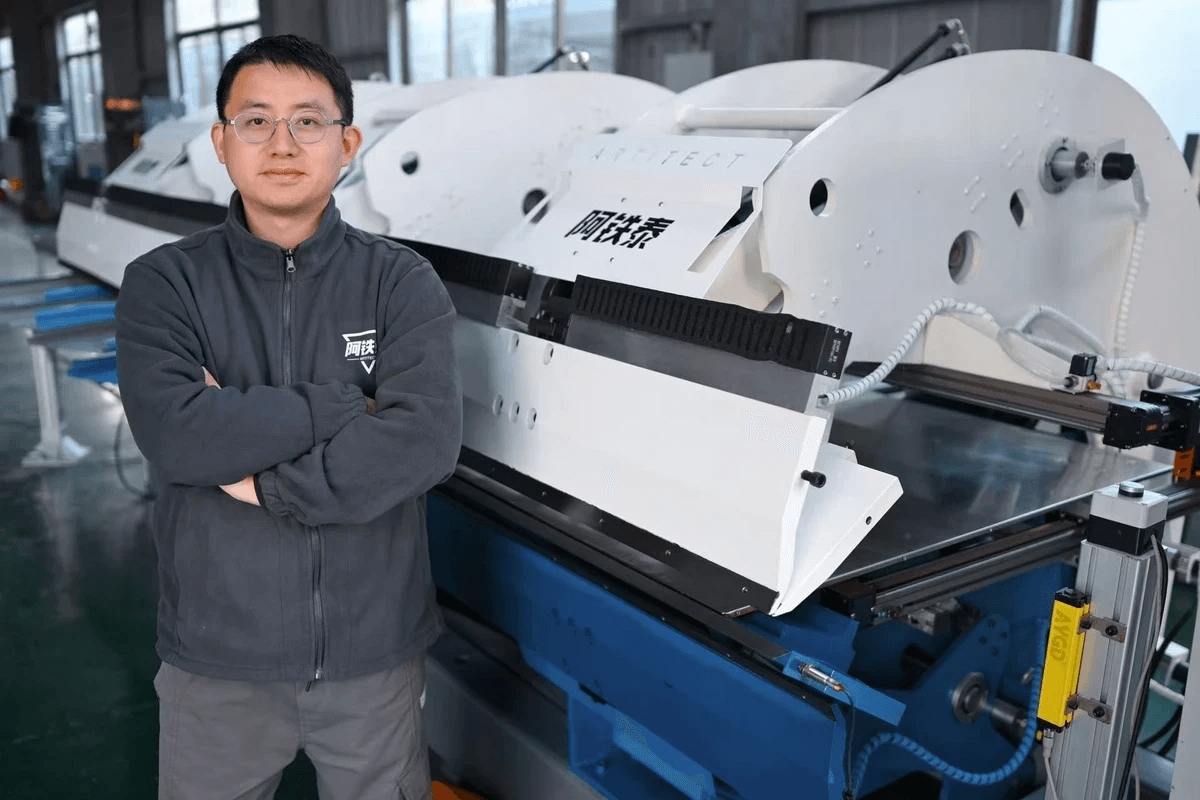
Roofing and architectural parts combine several difficult conditions: long lengths, alternating bends, visible finished surfaces, changing batch sizes, and a need for precision that survives operator turnover and production pressure. That is why the segment increasingly favors machines that reduce handling complexity instead of simply adding more mechanical seriousness.
Official competitor materials reinforce the same pattern. Jorns presents the JDB around simultaneous handling of complex profiles, open tooling geometry, loading systems, and individually driven clamping fingers. RAS stresses automated sequences and low-setup logic in up/down bending. CIDAN's FORMA Z emphasizes bending in both directions without flipping the material. Different brands, same industrial logic: the more complex the real work becomes, the more valuable controlled double-folder workflows become.
How to Decide if the Upgrade Is Worth It
The decision usually becomes clearer when buyers look at the current cost of their process instead of just the current price of their machine. Ask:
- How many labor minutes are lost per day to re-positioning and handling?
- How often do complex parts slow the whole production line?
- How much operator skill is required to maintain consistency today?
- How much finish-sensitive work is at risk from extra handling?
- Would stronger automation let the team process more work without proportional headcount growth?
If those questions point to handling, repeatability, and workflow control as the main bottlenecks, then the buyer is already thinking in double folder terms, whether or not that is how the search began.
Why Uptime and Training Matter in Industrial Folding
Industrial buyers often underestimate how much performance depends on day-two operation rather than day-one installation. A machine can look impressive in a showroom and still underperform if operators need too many workarounds, if programming habits are inconsistent, or if routine adjustments create unnecessary downtime. In high-mix production, these small interruptions compound quickly.
That is why training quality and operational clarity matter so much in this segment. A strong industrial folding machine should help standardize good operator behavior. Clear controls, predictable sequencing, and well-integrated handling systems reduce the amount of tribal knowledge needed to keep production stable. For businesses managing growth, shift changes, or operator turnover, that consistency is often just as valuable as raw machine capability.
Checklist for Shortlisting an Industrial Folding Machine
Before moving a supplier into the final shortlist, buyers should confirm that the machine answers the real industrial constraints of the shop:
- It can process the shop's longest common parts without unstable handling.
- It supports alternating bends without turning complex profiles into labor-heavy jobs.
- Its control system is understandable enough for repeat use across more than one operator.
- Its support, loading, or flipping systems solve real bottlenecks instead of adding decorative complexity.
- Its machine concept fits future automation goals, not just current throughput targets.
This kind of shortlist is more reliable than comparing only headline specifications. It keeps the decision tied to uptime, labor stability, and the real behavior of the machine under industrial production pressure.
How to Measure Industrial ROI More Realistically
Industrial ROI should be measured across the shift, not only across one sample part. Buyers should look at labor minutes saved, reduction in re-handling, stability of output through job changes, and the number of difficult parts that can be processed without creating a slowdown elsewhere in the shop. This broader view usually reveals more value than a simple speed comparison.
It also helps management compare investment options honestly. If a double folder allows the same team to process a more difficult order mix with fewer interruptions, then the gain is operational resilience as much as raw throughput. That is often the difference between a machine that merely joins the production floor and one that upgrades it.
Where ARTITECT MACHINERY Fits

ARTITECT MACHINERY positions itself around a double folder factory model and an application-driven sales approach. The brand's blog and consultation path both support that discussion. For buyers in roofing and architectural fabrication, that focus is useful because it keeps attention on workflow fit rather than on generic machine labeling.
Conclusion
An industrial folding machine should be judged by what it does to production, not only by how serious it looks on paper. For high-mix roofing and architectural work, the better benchmark is often a double folder workflow built around automation, handling control, and repeatability.
If your parts are long, complex, and finish-sensitive, and if your team needs more throughput without more chaos, then a double folder deserves to be at the center of the comparison. ARTITECT MACHINERY is positioned for exactly that kind of evaluation.